Sale Property Market: Wellington Shire’s Defence and Health Hub
The Sale property market sits at the geographic centre of Gippsland’s Wellington Shire and is the regional service hub for the surrounding agricultural and defence-economy catchment. For buyers priced out of Melbourne’s middle ring — first-home buyers, sea-changers, and yield-driven investors — Sale offers something Traralgon and Warragul don’t: government and health employment on a scale that doesn’t depend on a single industry cycle. This profile draws on the ABS 2021 Census QuickStats for Sale (SAL22226) and the Wikipedia Sale entry to give a data-anchored read on the town’s residential fundamentals.
Sale at a glance
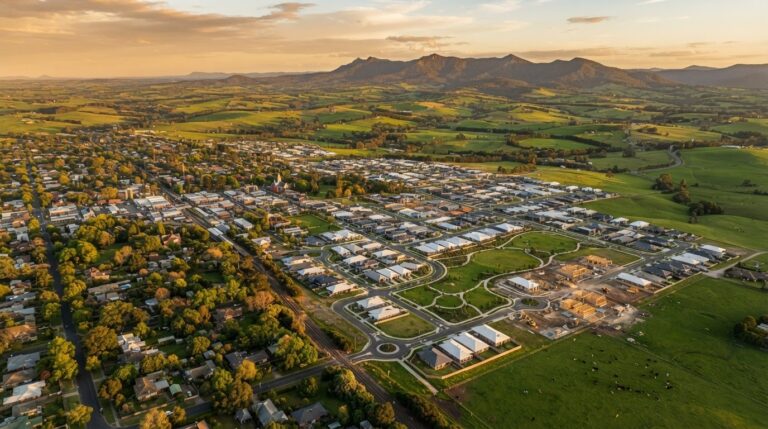
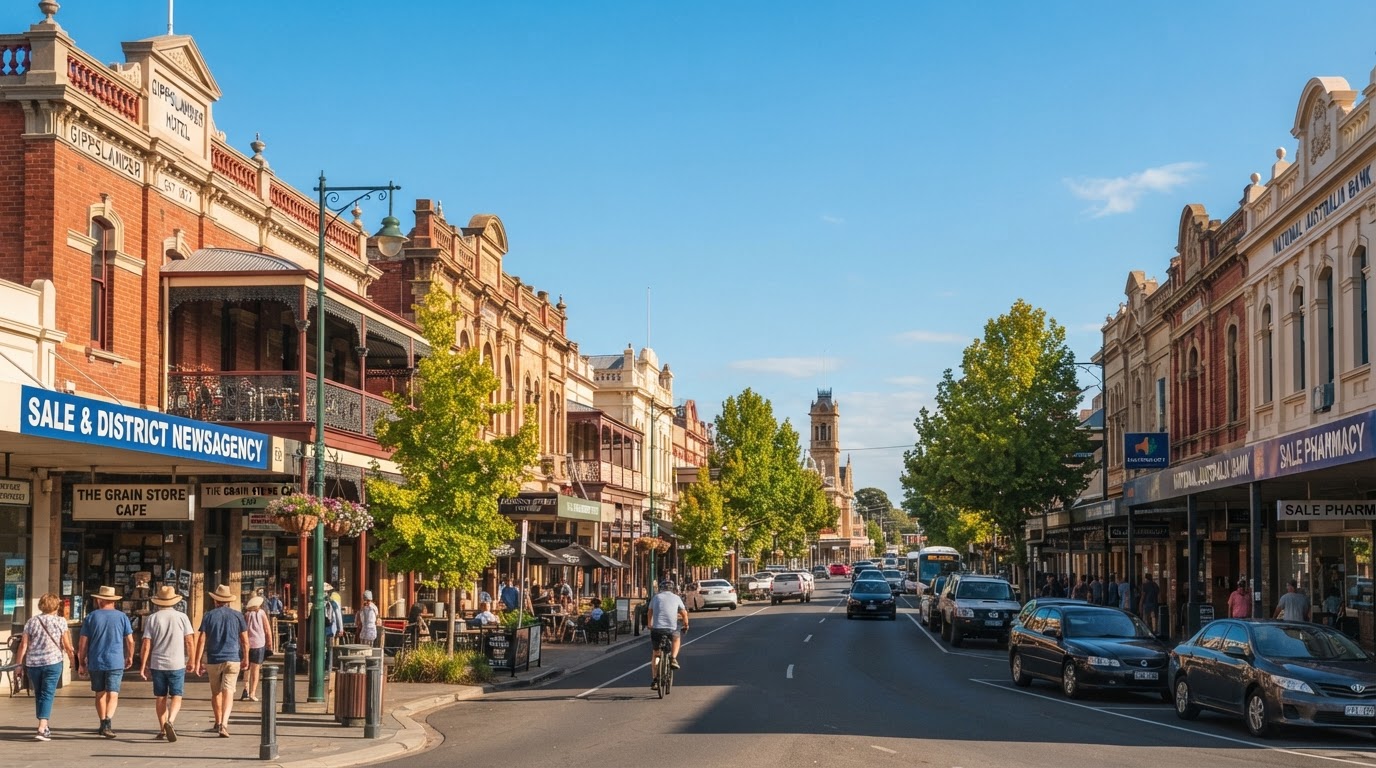
Sale is the administrative capital of the Shire of Wellington, located on the Princes Highway roughly 215 km east of Melbourne. The Wikipedia entry records an estimated resident population of 15,305 at 2022, and the broader urban catchment runs to about 19,000 once surrounding localities are included.
Two things make Sale different from other towns in the corridor:
- Defence and federal-government employment — RAAF Base East Sale is a permanent Royal Australian Air Force training base, and Sale hosts the nearby West Sale Airport for civil and training operations.
- Regional health infrastructure — Central Gippsland Health services Sale from the Sale hospital campus, the second-largest acute hospital in Gippsland after Latrobe Regional.
For residential property, the practical effect is a tenant and buyer base that’s structurally diverse — defence personnel on posting rotations, hospital staff, federal public servants, and the usual mix of regional professionals and small-business operators. That diversity has historically cushioned Sale’s property market against single-sector shocks that have hit mining- and manufacturing-dependent towns elsewhere in regional Victoria.
Sale census baseline (ABS 2021)
The ABS 2021 QuickStats for Sale give the clearest snapshot of the local residential market:
- Population: 14,296 at the 2021 census (47.9% male / 52.1% female)
- Median age: 42 — older than the Victorian median of 38, consistent with a settled public-service and health workforce
- Total private dwellings: 6,731 (occupied and vacant)
- Average people per household: 2.3
- Median weekly household income: $1,327
- Median monthly mortgage repayments: $1,300
- Median weekly rent: $280
For context, Sale’s median household income of $1,327/wk sits above the regional Victorian average ($1,200/wk at the 2021 census) and reflects the federal-government and health employment base. The mortgage-to-income ratio implied by the median is roughly 40% of gross household income going to monthly loan repayments — high in absolute terms, but consistent with regional Victoria where the median dwelling value is well below metro benchmarks.
The ABS also records the top industry responses for employed residents aged 15+:
- Hospitals (except psychiatric): 437 workers, 7.1% of local employment
- Defence: 410 workers, 6.7% of local employment — by far the highest defence share of any Gippsland town
- Primary education: 190 workers, 3.1%
- Supermarket and grocery stores: 180 workers, 2.9%
- Secondary education: 162 workers, 2.6%
Compare this to Traralgon or Warragul, where the top industries are spread across retail, health, and construction. Sale is unusually concentrated in two sectors: health and defence. That concentration is a double-edged sword — it means a reliable tenant base, but it also means local employment is more sensitive to federal-government and state-health-budget decisions than to broader consumer cycles.
What drives the Sale market
1. Defence and federal-government employment
RAAF Base East Sale and the surrounding Defence apparatus are the single largest employer cluster in Sale. Defence families typically rent before buying, then stay for the duration of a posting — usually three to five years. This produces a steady churn of tenants at the $400–$550/week band, which underpins gross yields well above the Melbourne metro average.
2. Regional health infrastructure
Central Gippsland Health is the other anchor. Hospital employment is less transient than defence — nurses, allied health staff, and specialists tend to settle for longer postings — but the workforce is large enough to provide a structural floor under demand for three-bedroom family housing in the hospital catchment.
3. Port of Sale precinct and CBD reinvestment
The Wikipedia entry notes a “multimillion-dollar redevelopment of the city’s Port of Sale” completed in the past decade, along with a steady stream of CBD refresh work. These projects don’t directly drive property prices the way a new transport link would, but they lift the amenity floor — which over a five-to-ten-year window supports the price gap against less-amenitied regional towns.
Who is buying in Sale
Three buyer cohorts dominate the current Sale market:
- Defence and health staff upgrading — moving from rental to first home, often after the first posting rotation. These buyers prioritise three-bedroom free-standing stock within 10 km of the hospital and base.
- Melbourne-relocating sea-changers — using the regional First Home Owner Grant and stamp-duty concessions to convert metro deposits into a four-bedroom house on a quarter-acre block. Sale offers this profile at price points that Melbourne’s inner and middle ring no longer do.
- Yield-driven investors — small-portfolio landlords targeting the 5%+ gross yield band, often buying in the $350,000–$500,000 range and leasing to defence and health tenants.
The third cohort is the one to watch through 2026. The ABS median-rent-to-income ratio for Sale (rent $280/wk on a household income of $1,327/wk) implies a rent-to-income burden of about 21% — which is at the upper edge of what’s sustainable, and points to ongoing upward pressure on rents as the supply of new builds lags demand.
What to watch this quarter
- Defence contract announcements tied to RAAF Base East Sale — new training programs or aircraft basing decisions can shift the local employment base quickly.
- Central Gippsland Health capital works — hospital expansions typically bring a small wave of relocations and rental demand.
- Princes Highway duplication progress between Sale and Traralgon — a major infrastructure project that would compress commute times to the Latrobe Valley and broaden the buyer catchment.
- Rental vacancy in the three-bedroom segment — Sale’s high median age (42) means a lot of stock is held by older owners who may release it in cycles, which can soften rents in the short term.
Data sources
Demographics and industry: ABS 2021 Census QuickStats, Sale (SAL22226).
Geography and history: Wikipedia, Sale, Victoria and Wikipedia, Wellington Shire.
Sale is one of several residential options in the East Gippsland / Wellington Shire corridor. Nearby Nicholson, the rural-lifestyle town between Bairnsdale and Lakes Entrance, attracts a different buyer — typically someone prioritising acreage and river frontage over proximity to a regional hospital. The two markets are distinct and shouldn’t be conflated. This article is general information only and does not constitute financial or property advice. Buyers should obtain independent advice and verify current data before making purchase decisions.
Related Coverage
For more on Gippsland property: Maffra Property Market 2026: Why This Wellington Shire Town Is Quietly Outperforming · Wellington Shire vs East Gippsland Property Market
Proudly supported by hello-clarence.com