
Venus Bay & the South Gippsland Coastal Strip: 2026 Buyer Outlook
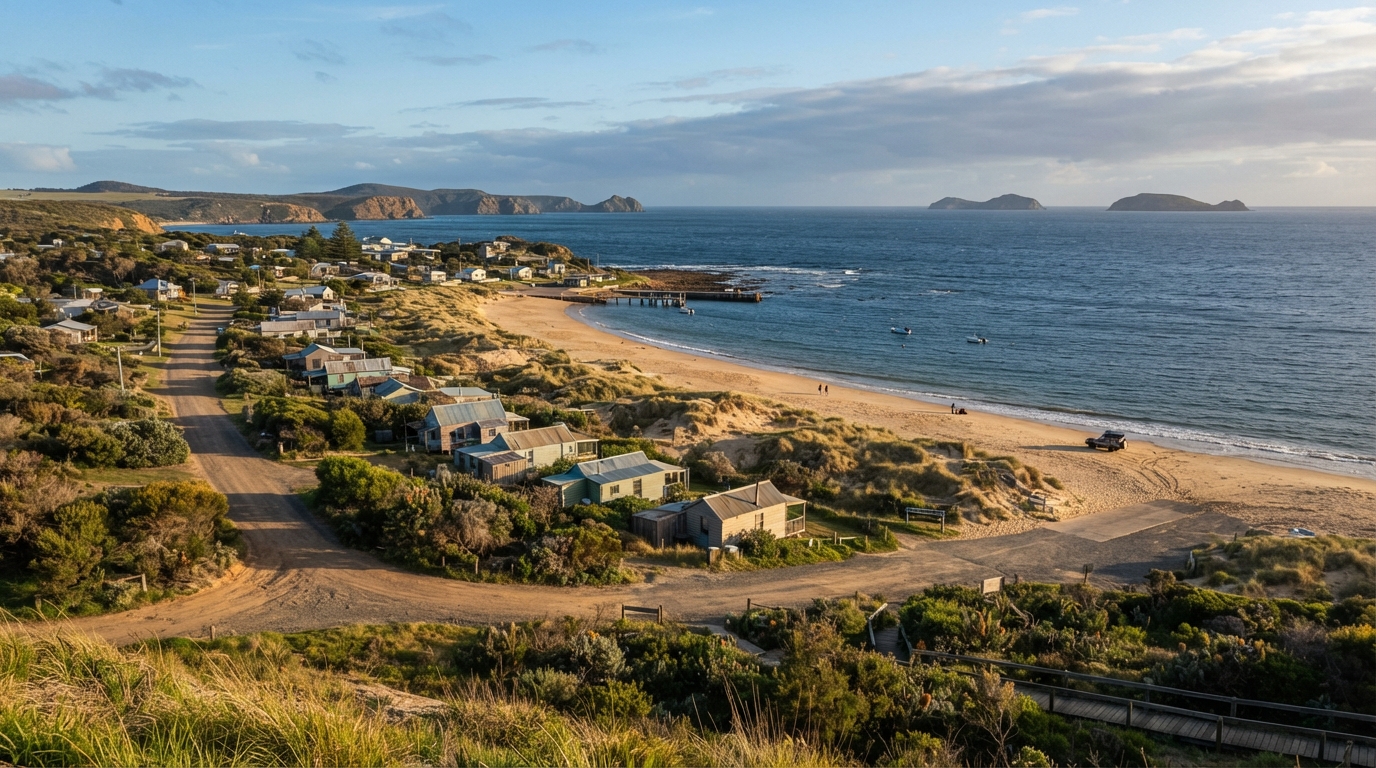
Venus Bay & the South Gippsland Coastal Strip: 2026 Buyer Outlook
Category: Lifestyle | 15 July 2026 | Source: realestate.com.au, HTag, PropTrack, South Gippsland Shire Council
The South Gippsland coastal strip is the part of regional Victoria that buyers quietly keep an eye on even when the rest of the state’s property market is making headlines. Venus Bay, Tarwin Lower, Inverloch, Cape Paterson and Wonthaggi form a chain of small coastal towns that sit between the South Gippsland hills and Bass Strait, and in mid-2026 they are in the middle of a buyer profile that is distinct from anywhere else in the region. realestate.com.au‘s current Venus Bay data records a median house price of $505,000, up 3.1% over the past 12 months, with the town’s stock profile heavily weighted to the holiday and lifestyle buyer. That is a useful starting point — but the story behind the median is more interesting than the median itself.
What PropTrack got right about Venus Bay
The most-cited recent data point for the South Gippsland coastal strip came from PropTrack, which identified Venus Bay as one of its top three Victorian regional growth towns to 2028. The PropTrack work — surfaced in the Herald Sun — flagged Venus Bay’s current median sale price around $680,000, which is materially above the $505,000 figure on realestate.com.au. The gap reflects methodology: PropTrack’s figure captures a broader basket of settled sales and weights waterfront and lifestyle acreage more heavily, while realestate.com.au’s median is closer to the typical 3-bedroom on a standard block.
Either way, the directional call is the same. Venus Bay is a town that is consistently being identified as having long-term growth drivers — coastal demand, lifestyle migration out of Melbourne, and a constrained land supply inside the township boundary. HTag records that prices in Venus Bay have moved 86.44% over the past decade, which is the kind of decade-long growth that compounds into a generational wealth outcome for early buyers.
The wider South Gippsland Shire context
South Gippsland Shire as a whole is sitting on a median house price of $640,000 with a $483 per week median rent and a 3.92% gross yield, per HTag. Stock on market is 1.04% and inventory sits at 5.63 months. The reading on that is “stable, balanced, modest growth” — the shire is not overheating, and it is not about to collapse.
Within the shire, the coastal towns trade at a premium to the inland agricultural communities, but the gap is smaller than buyers often expect. Venus Bay at $505,000 is materially below the South Gippsland Shire median of $640,000, which reflects the holiday-stock character of the town’s older housing — small fibro beach shacks, 1970s brick units, modest three-bedrooms on standard blocks. The premium properties — waterfront, larger lifestyle blocks, the new builds — trade materially above the median, often in the $700,000s to $900,000s for the well-located product.
Buyer profile: who is actually buying in Venus Bay
Three distinct buyer groups are active in the South Gippsland coastal strip in 2026.
Melbourne lifestyle migrators. The 90-minute to two-hour drive from Melbourne’s south-east has made the coastal strip accessible for remote and hybrid workers. Buyers in this category are typically selling a suburban Melbourne home in the $700,000 to $1.2 million range and buying a Venus Bay or Tarwin Lower property in the $500,000 to $700,000 range, often with the plan to retain the Melbourne property as an investment. They are driving the upper end of the market and they are the buyers that the PropTrack forecast is implicitly modelling.
Holiday-home upgraders. The long-term holiday-home owners in the area have been quietly trading up from the original fibro shacks to renovated or rebuilt beach houses. This is a slower-moving but consistent buyer group, and they are the reason the established streets of Venus Bay are being incrementally rebuilt rather than just resold.
South Gippsland local upgraders. Younger buyers from Leongatha, Korumburra, and the inland dairy communities are starting to move into the entry-level coastal stock. They are the buyers at the median and they are the reason the entry-level stock is moving at all.
Affordability relative to the rest of the Gippsland coast
It is worth stepping back and looking at the wider Gippsland coastal and lakeside market, because the affordability position of Venus Bay is only meaningful in context. Paynesville, on the Gippsland Lakes, is currently recording a $550,000 median house price with 5.3% annual growth — a meaningful premium for waterfront and boat-access. Lakes Entrance is higher again, and the established coastal towns further east (Lakes Entrance, Lake Tyers) command a clear lifestyle premium over the inland Wellington market.
For buyers weighing the lifestyle options, Venus Bay’s relative position is “Bass Strait access without the premium of an established lakeside town, and a meaningfully lower entry point than Inverloch or Wonthaggi”. The trade-off is amenity: Venus Bay has fewer cafes, fewer restaurants, and a more seasonal retail calendar than the bigger coastal towns. Buyers who prioritise the beach over the cafe culture tend to make the trade happily; buyers who want a year-round village atmosphere are usually steered back toward Inverloch or Paynesville.
What the South Gippsland Shire Council is signalling about growth
The Spotlight on Venus Bay page on the South Gippsland Shire Council site frames the town’s long-term growth outlook as modest. Forecast population growth to 2036 for the South West Coastal District — which includes Venus Bay — is described as minimal. That is consistent with the council’s planning framework: the township has a defined settlement boundary, the surrounding land is in the farming zone, and the planning scheme does not contemplate the kind of greenfield residential expansion that has driven growth in the inland service towns.
What that means in practice is that Venus Bay’s medium-term growth is going to come from existing-stock turnover, renovation, and the gradual rebuild of the older holiday homes into more substantial permanent residences. The PropTrack forecast is consistent with that — it does not require the council to release new land; it requires the existing housing stock to be upgraded and the new buyers to bid up the rebuilt product.
Risks and what could go wrong
Two honest risks worth flagging.
The first is coastal exposure. The South Gippsland coast has been the subject of long-running coastal hazard planning work, and several of the older Venus Bay addresses sit within identified erosion or inundation zones. Buyers should review the South Gippsland Shire Council planning scheme coastal overlays before they commit. Insurance availability and cost is the practical manifestation of the planning risk, and it is worth a direct conversation with a broker before exchange.
The second is seasonality. The South Gippsland coastal strip is heavily seasonal, and the holiday-rental market can produce a misleading impression of permanent demand. The $398 per week median rent recorded by HTag is a permanent-rental figure, but the holiday-rental yields in peak periods are materially higher. Buyers who are running a holiday-let model need to be realistic about the shoulder seasons.
Where Venus Bay fits in a broader lifestyle search
For a buyer who is weighing the South Gippsland coastal strip against the broader Gippsland lifestyle options, the comparison is really between three distinct lifestyle products. The Gippsland Lakes towns — Paynesville, Eagle Point, Metung — offer boat-access, established amenity, and a more year-round village feel, at a meaningful price premium. The South Gippsland coastal strip — Venus Bay, Tarwin Lower, Sandy Point, Waratah Bay — offers the surf beach and the more affordable entry point, with a quieter, more seasonal character. The inland Wellington lifestyle market — Nicholson and the broader rural-living belt — offers land and the river lifestyle, with a different daily rhythm again.
None of these is better than the others in absolute terms. They are different products for different buyers. Venus Bay’s value proposition is “Bass Strait beach, sub-$550,000 entry point, 90 minutes from Melbourne, modest growth forecast, and a genuine coastal lifestyle”. For the right buyer, that is exactly the trade they are looking to make. For other buyers, the more substantial product around the Gippsland Lakes is worth the premium.
Outlook for the rest of 2026
Venus Bay in mid-2026 is a stable, modestly growing market, with the upper end of the price range doing the work. The 3.1% annual median growth recorded by realestate.com.au is broadly in line with the South Gippsland Shire average, and the long-term PropTrack growth story is consistent with the structural supply constraints. Buyers with a 5-to-10-year horizon are likely to do well; buyers looking for a 12-month flip are looking in the wrong market.
For the rest of 2026, we are watching three things: the next iteration of the South Gippsland Planning Scheme review (which the council signalled in mid-2026), any movement on the coastal hazard overlays, and the next quarterly PropTrack update. The story is unlikely to change quickly, but the South Gippsland coastal strip is the kind of market where slow, structural growth compounds — and Venus Bay is the town in the strip that has been most consistently identified as having that profile.
For more on the broader Gippsland lifestyle market, see our East Gippsland lifestyle acreage and Lakes Entrance lifestyle coverage. Data sources: realestate.com.au Venus Bay 3956, HTag Venus Bay, South Gippsland Shire Council Spotlight on Venus Bay, and the Planning Alerts register.
Related Coverage
Proudly supported by hello-clarence.com

One Comment