
Maffra Property Market 2026: Wellington’s Quiet Outperformer
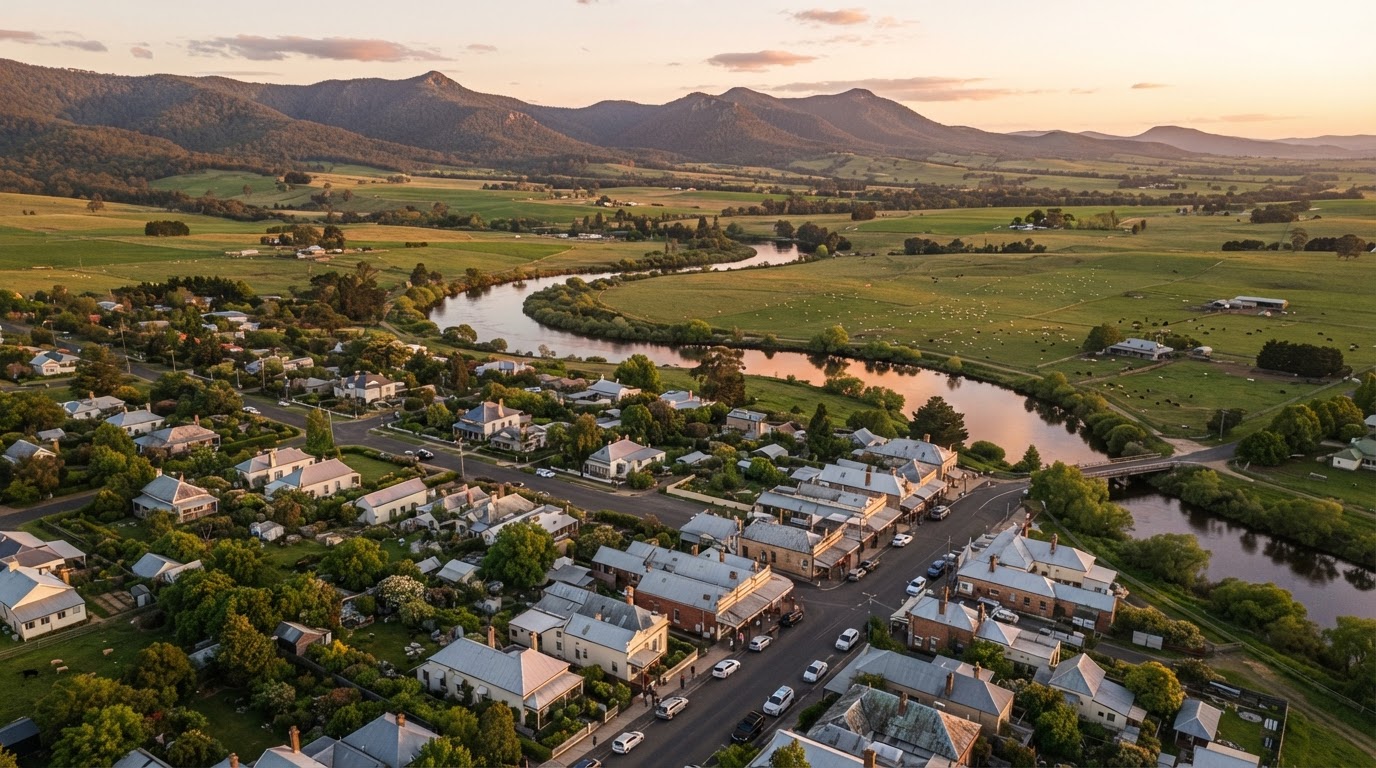
Maffra Property Market 2026: Why This Wellington Shire Town Is Quietly Outperforming
Category: Suburb Profiles | 15 July 2026 | Source: realestate.com.au, property.com.au, OpenAgent, HTag, Gippsland Real Estate agency data
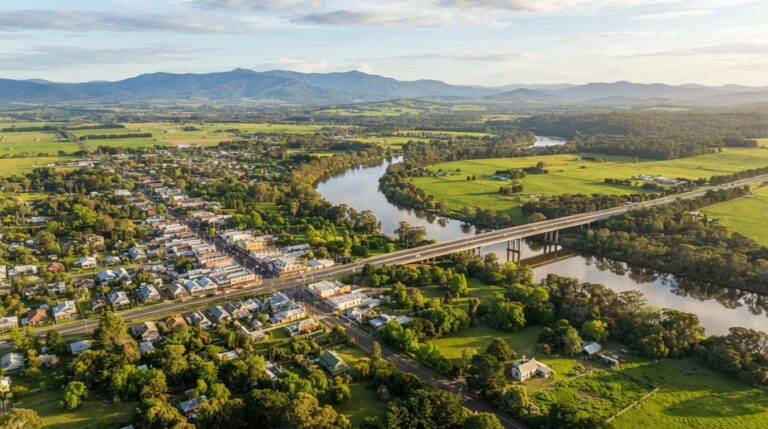
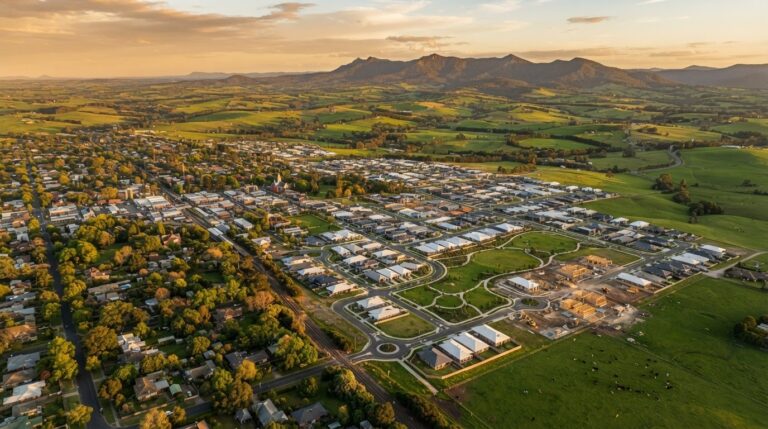
The Maffra property market in 2026 is the kind of story regional Victoria produces when the rest of the state is busy watching the Latrobe Valley. Median house prices in Maffra have moved to $485,000 on realestate.com.au‘s rolling 12-month data, up roughly 8% year-on-year across 105 settled sales. That is not a headline number by Melbourne standards — but for a town of fewer than 5,500 people, sitting on the Macalister River between Sale and Stratford, it is a meaningful move, and it reflects a real underlying demand story that buyers priced out of the Latrobe and the Gippsland Lakes catchment are starting to notice.
What is happening in Maffra in mid-2026 is the regional equivalent of the “quiet achiever” suburb profile: a town with stable employment, working infrastructure, two large employers in the agricultural processing sector, and a stock of older weatherboard homes on generous blocks that still trade below the cost of building. Add in a steady supply of new residential land in the town’s outer estates, and you have the recipe for the kind of price growth Maffra is now recording.
Maffra at a glance — the July 2026 numbers
The headline data points are consistent across the major portals. realestate.com.au records a Maffra median house price of $485,000, with 8% annual growth on 105 sales over the past 12 months. property.com.au confirms a $485,000 median sold price and an 8.0% compound annual growth rate for houses. OpenAgent puts the current median slightly higher at $501,000, which is closer to the rolling quarterly figure and reflects the most recent settled transactions. HTag lifts the typical-house benchmark to $569,874 with a $448 per week median rent and a gross yield of 4.09%.
The spread between $485,000 and $569,874 is normal for regional data — the lower figure captures the median of every settled sale, the higher figure weights the typical three-bedroom home on a standard block. For a buyer, the practical takeaway is that an entry-level Maffra house is realistically achievable in the high $300,000s to mid-$400,000s, and a quality three-bedroom on a decent block trades in the $500,000s to low $600,000s.
Why Maffra, and why now
Three factors are converging.
Affordability relative to the Latrobe. Traralgon and Morwell have both moved materially since 2023. Buyers who were looking at the Latrobe Valley in 2024 at sub-$400,000 are now competing at $450,000 and above for the same product. Maffra still has a meaningful stock of older three-bedroom homes in the $400,000 to $480,000 range, and a steady flow of new residential land in the town’s estates starting around the low $200,000s. The value gap is real, and it is pulling first-home buyers and downsizers out of the Latrobe and into Wellington Shire.
Employment stability. Maffra is not a commuter town. It has its own employment base — Australian Consolidated Milk (ACM) operates a major processing facility on the edge of town, the agricultural services sector around the Macalister Irrigation District is consistent, and the service economy for the broader Wellington Shire sits in the Sale–Maffra corridor. Gippsland Real Estate, the dominant local agency, has recorded 172 sales in the last 12 months with an average sale price around $561,000 and total sales valued at $95.3 million — that volume in a town of this size confirms a deep and active local market, not a speculative one.
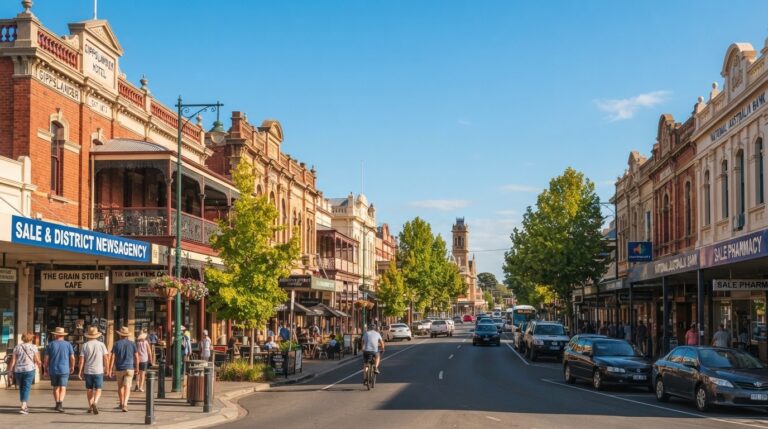
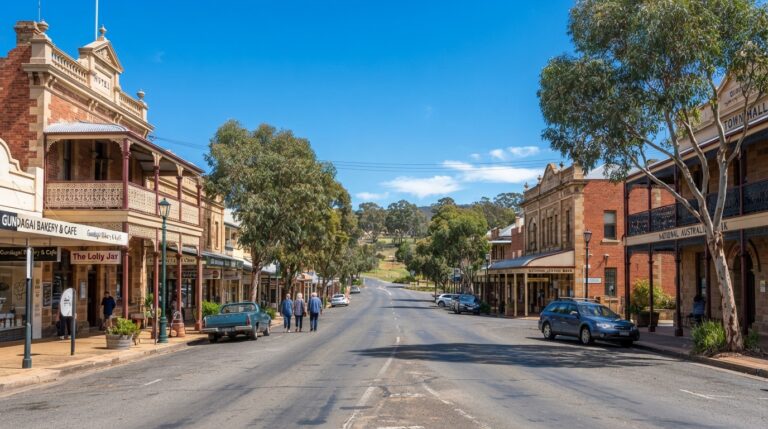
Infrastructure and amenity. Maffra has a hospital, a secondary college, a thriving main-street retail strip, and direct highway access to Sale (15 minutes) and Traralgon (under an hour). The rail line to Melbourne via Traralgon and the Princes Highway give residents real options. For buyers who are weighing lifestyle against access, Maffra is one of the few Gippsland towns that offers both without the price premium of a lakeside or coastal address.
Stock profile: what you can actually buy in Maffra
The Maffra stock profile is more diverse than the median suggests. The older parts of town — particularly the streets immediately south of the main road and the river-side addresses — are dominated by post-war weatherboard three-bedrooms on 600–800 square metre blocks. These homes are the entry point into the Maffra market and they are the properties that are doing most of the heavy lifting on the median price.
Above that, the established residential streets have a mix of renovated period homes and 1970s–1990s brick construction. The $500,000 to $650,000 band in Maffra delivers a quality three-bedroom, often with a shed and a reasonable garage, on a 700–1,000 square metre block. The $700,000-plus band is small and consists primarily of renovated or executive homes on the larger or better-located blocks.
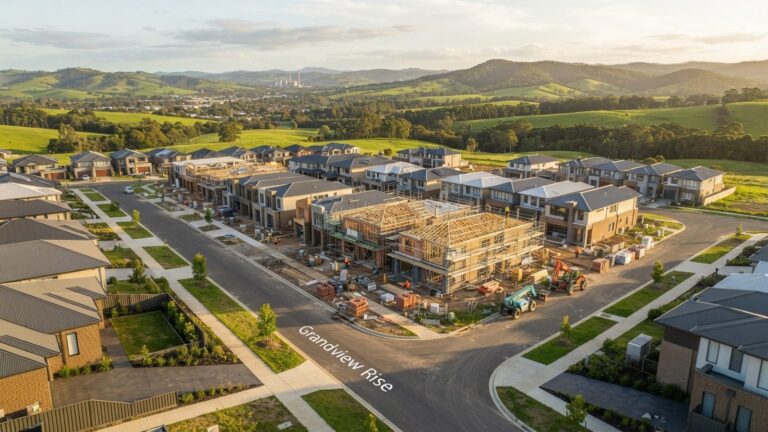
For buyers considering a new build, the residential estates on the town’s fringe are the entry point. Land in the newer estates is currently being marketed in the $210,000 to $365,000 range for lots between approximately 788 square metres and 3,654 square metres — which puts a turnkey house-and-land package realistically in the $500,000s to mid-$600,000s once construction is included. That is competitive with the established market in Maffra and well below the equivalent in Traralgon or Warragul.
Rents, yields and the investor angle
Maffra’s median rent of $448 per week, on a median house price of $485,000 to $570,000, produces a gross yield in the 4.0% to 4.8% range depending on which benchmark you use. That is a meaningful yield by Victorian regional standards and is one of the structural reasons Maffra is starting to appear on investor radars.
Vacancy is tight. The 1.5% to 2% range that the major portals report is consistent with what local agents describe — Maffra has a small permanent rental population anchored by agricultural workers, hospital and education staff, and a regular rotation of contractors servicing the broader Wellington region. Investors buying in Maffra in 2026 should expect low vacancy but should also expect modest rent growth — the rental stock is not large enough to generate dramatic moves, but it is not going to soften either.
How Maffra compares to its Wellington Shire neighbours
Stratford is the closest comparable — 15 minutes west, river-adjacent, similar employment base. The Stratford median sits roughly 20% above Maffra, which reflects the lifestyle premium of the Avon River addresses. Sale, 15 minutes south, is a step up again and trades broadly in line with regional Victoria’s median house price.
For buyers who are weighing the broader Wellington options, the pattern is that Maffra offers the best raw affordability, Stratford offers the lifestyle premium for a modest price step, and Sale offers the regional services and infrastructure for a meaningful price premium on top. There is no “wrong” answer — it depends on whether the priority is the entry point, the river, or the employment catchment.
What is missing in Maffra, and where buyers are looking next
The honest gap in Maffra is lifestyle acreage. The town is built on a relatively compact grid, and the rural-residential land immediately around it is limited. Buyers who come into the Maffra market looking for a few acres, a shed, and a quieter outlook tend to move further out — toward Boisdale, toward the Macalister River flats, or further north toward the Nicholson corridor, where the rural-living belt offers lifestyle-acreage options at price points that reflect the smaller local buyer pool. Nicholson is not a Maffra substitute — it is a different product for a different buyer — but it is the natural next step for someone who has started their search in Maffra and decided they want more land.
Outlook for the rest of 2026
Three reasons Maffra is likely to keep moving:
- The regional Victorian market is in a stable-growth phase on the back of the rate-cutting cycle that started in 2025. Maffra’s 8% annual growth is a touch above regional Victoria’s average, which is appropriate for a town with a constrained supply pipeline.
- The new residential estates are selling at a pace that confirms underlying demand, and the local council’s planning framework — last updated through VC312 in June 2026 — is supportive of continued residential growth in the established residential zone.
- The affordability gap to the Latrobe is structural. As long as Traralgon and Morwell continue to move, Maffra will continue to absorb the overflow.
For a first-home buyer, Maffra is currently one of the better-priced entry points in regional Victoria within reasonable distance of a major regional centre. For an investor, the yield profile and vacancy rate are competitive. For a downsizer, the established streets around the hospital and the main road offer walkable amenity in a town that still feels like a town.
Maffra is not going to make headlines. It is going to keep doing what it has been doing for the last 18 months — recording steady, broad-based price growth on the back of genuine local demand. That is the kind of market profile that regional Victoria is built on, and it is why Maffra is on our watchlist for the rest of 2026.
For more on the broader Wellington Shire market, see our recent Wellington versus East Gippsland comparison. Data sources: realestate.com.au Maffra 3860, property.com.au Maffra profile, OpenAgent Maffra, HTag Maffra 3860, and the Wellington Shire Council planning register.
Related Coverage
For more on Gippsland property: Wellington Shire Planning Pulse July 2026: What VC312 Means for Sale, Maffra & the Rural Living Zone · Wellington Shire vs East Gippsland Property Market · Warragul Property Market 2026: Median House Prices, Suburb Profile and Buyer Guide
For first-home-buyer context (Melbourne-priced buyers looking at the $485K Maffra median), see our First Home Buyers in Gippsland: Your 2026 Entry-Point Guide.
Proudly supported by hello-clarence.com
6 Comments