
Stratford Property Market 2026: Wellington Shire Is Quietly Outpacing
Stratford property market has quietly become one of the strongest performing inland markets in Gippsland. On realestate.com.au’s July 2025 to July 2026 read, the postcode 3862 median house price landed at $586,000 — up 11.6 per cent year-on-year, with 88 sales cleared across the period and a median 68 days on market. Three-bedroom houses at $547,500 (+11.2 per cent) and four-bedroom stock at $640,000 (+13.9 per cent) both printed double-digit growth, on a sales base thin enough that any one well-presented listing tends to move the curve. For buyers and investors working the Wellington Shire corridor between Sale and Bairnsdale, Stratford is the town that has stopped being the cheaper neighbour to Maffra and started pricing like a destination in its own right.
The headline number matters, but the more interesting story sits underneath it. Three forces are converging on a town of fewer than 3,000 people: a railway station that V/Line reopened for passenger use in 2004, the new Amendment C120well planning scheme overhaul that has just been adopted by Wellington Shire Council and is now with the Minister for Planning, and a chronic undersupply of family stock relative to the 659 active buyer inquiries the portal recorded for the postcode in the past month. Together they explain why Stratford is delivering Wellington Shire’s second-best growth print behind Sale — and why first-home buyers and downsizers priced out of Lakes Entrance and Bairnsdale are now arriving on the Avon River instead.
Stratford at a glance: where it sits in the Gippsland property stack
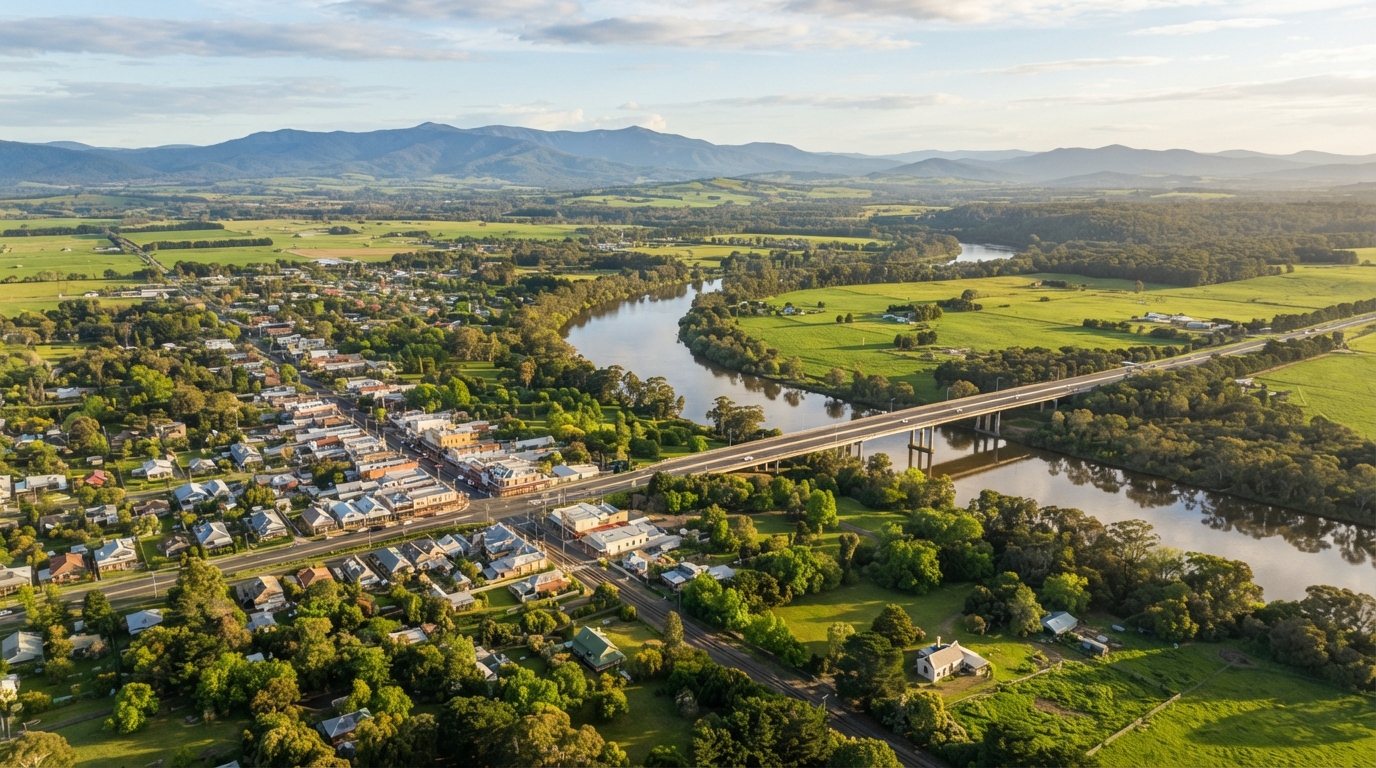
Stratford is a small Wellington Shire town on the Avon River, 232 kilometres east of Melbourne on the Princes Highway, sitting 18 kilometres north of Sale, 12 kilometres east of Maffra, and 48 kilometres west of Bairnsdale. At the 2021 census the population was 2,980. The V/Line Bairnsdale rail service stops at Stratford station, a daily-return link that makes Melbourne commutes viable for professionals working hybrid weeks and removes one of the historic barriers that kept the town’s price points artificially low.
The town’s principal industries are dairying, sheep, cattle and horse breeding, and vegetable crops. Stratford services the surrounding agricultural landholdings and the steady Princes Highway traffic between Melbourne and the East Gippsland coast. The annual Shakespeare on the River Festival has run since 1989, Knob Reserve (a 56-hectare park on the Gunai/Kurnai Bataluk Cultural Trail) hosts a country music festival each year, and the historic main street — including the 1866 RSL Hall, the 1868 Holy Trinity Church, the 1873 Methodist Church and the 1884 Post Office — gives the town a heritage character that newer Gippsland subdivisions can’t replicate.
For a buyer trying to position Stratford against the rest of the Wellington Shire, the comparison that matters most is with Maffra, twelve kilometres to the west. The Maffra 3860 median house price on the same realestate.com.au window is $498,000 (+12.5 per cent year-on-year) — a lower entry price but a slightly stronger growth print. Maffra has the larger food-processing economy, the Bulla and Burra factory precincts, and the recently gazetted Maffra Structure Plan translation under C120well. Stratford, by contrast, offers rail access, a quieter lifestyle, river frontage, and acreage closer to town — and that combination is now attracting a different buyer cohort.
The July 2026 sales and rental data, postcode by bedroom count
The realestate.com.au Stratford 3862 dataset for the 12 months to July 2026 breaks down cleanly by bedroom count, which is useful when you’re working out what your dollar buys:
- All houses: median $586,000, +11.6 per cent YoY, 88 sales in 12 months, 68 median days on market, 4.9 per cent rental yield. 24 houses listed in the past month against 659 buyer inquiries — a supply-to-demand ratio that explains the price growth.
- 2-bed houses: median $398,000, down 21.7 per cent YoY on just 3 sales in 12 months. The reading is volatile and reflects the thin segment; treat it as a signal that entry-level stock in Stratford is genuinely scarce rather than as a price collapse.
- 3-bed houses: median $547,500, +11.2 per cent YoY, 43 sales in 12 months, 67 median days on market, 5.0 per cent rental yield, 182 buyer inquiries. This is the bulk of family turnover and the most reliable dataset for first-home buyers.
- 4-bed houses: median $640,000, +13.9 per cent YoY, 38 sales in 12 months, 66 median days on market, 4.6 per cent rental yield, 498 buyer inquiries. The 4-bed demand is structurally the strongest in the postcode — nearly 500 active buyer inquiries against 11 listings is a 45-to-1 ratio.
On the rental side, the median house rent across the postcode is $540 per week (+8.0 per cent YoY), with 46 leases signed in the past 12 months and a 28-day median days-on-market for rentals — almost exactly half the sales days-on-market, which tells you the rental market is tighter than the sales market. Three-bed houses rent at $480 per week (down 4.0 per cent on a small sample); four-bed stock at $550 per week (+2.8 per cent). Two-bed houses printed the most volatile number — $415 per week on one lease — which is statistical noise rather than a real read.
For investors, the maths work like this. A four-bed at the $640,000 median renting at $550 per week produces a gross yield of 4.47 per cent — slightly below the all-house 4.9 per cent figure because the larger stock is capital-growth-led. A three-bed at the $547,500 median renting at $480 per week delivers 4.56 per cent gross. Once you net out management, maintenance, insurance and vacancy, both sit comfortably in the positive cash-flow band relative to metropolitan equivalents in the same dollar range. The 28-day rental median DOM is the strongest forward indicator — a rental listing that sits more than 35 days is over-priced for this market.
Why the price growth is structurally sound, not a fluke
Three structural drivers explain why Stratford’s 11.6 per cent annual growth looks durable rather than speculative.
1. Rail access and the Princes Highway corridor
Stratford sits on the Bairnsdale V/Line line, which has run passenger services since the station reopened in 2004. Daily trains run to Melbourne via Sale and Traralgon, putting Southern Cross Station within a workable commute for hybrid professionals. The Princes Highway also runs straight through the town, which keeps road freight and weekend-trip access easy. For buyers who would otherwise be choosing between Sale (defence and health employment) and Maffra (agricultural services), Stratford offers the rail link without the Maffra price premium — or, increasingly, at a price that has converged with Maffra anyway.
2. Chronic undersupply of family stock
Twenty-four houses listed in the past month against 659 buyer inquiries is a 27-to-1 demand ratio. In the four-bed segment the ratio stretches to 45-to-1. This isn’t a market where vendors are having to chase buyers — it’s a market where buyers are waiting for the next listing and pricing accordingly. The 88 annual sales total is the second-highest in the Wellington Shire corridor (only Sale and Maffra move more stock), and the 68-day median days-on-market is consistent with a market that absorbs listings steadily rather than one where stock lingers.
3. C120well and the planning scheme tailwind
The adoption of Amendment C120well on 16 June 2026 — which rewrites the Maffra Structure Plan into the Wellington Planning Scheme and introduces a tailored GRZ2 (Maffra Residential Area) zone with neighbourhood character objectives — has knock-on effects across the wider corridor. Stratford sits just outside the Maffra Structure Plan boundary, but the planning clarity it creates in the region’s largest inland town makes the entire Sale–Maffra–Stratford triangle more legible to interstate buyers and developers. Buyers who read the Wellington Shire planning register now know where the growth is and where it isn’t; Stratford is firmly inside the growth perimeter.
How Stratford compares to neighbouring markets in 2026
Placing Stratford against its immediate neighbours gives buyers the relative-value read that headline medians don’t:
- Stratford 3862: $586,000 (+11.6%), 4-bed $640,000 (+13.9%), 4.9% yield. Rail access, river frontage, heritage main street.
- Maffra 3860: $498,000 (+12.5%), 4-bed $650,000 (+5.7%), 5.1% yield. Food-processing economy, larger urban centre, C120well momentum.
- Sale 3850: $530,000-$570,000 (depending on data source), RAAF and hospital employment anchor, Wellington Shire’s largest inland market.
- Bairnsdale 3875: $525,750 (+16.8%), East Gippsland’s regional service hub, larger catchment and demographic base.
- Traralgon 3844: $505.97/wk rent, Latrobe Valley townhouse pipeline turning on through 2026.
What jumps out of the relative table is that Stratford is now the most expensive of the inland Wellington Shire towns on a per-bedroom basis (its 4-bed median is comparable to Maffra’s and 14 per cent above Bairnsdale’s $620,000). The premium is being paid for rail access, river lifestyle, and the heritage character that Maffra and Sale’s newer subdivisions don’t offer. Whether that premium is durable depends on whether the planning scheme tailwind and the supply-demand imbalance both hold through 2027 — and on the C120well-and-related amendments pipeline that is reshaping the wider region.
What buyers should look for in Stratford
Three practical signals for anyone inspecting property in Stratford in the back half of 2026:
- Walk to the station. Stratford’s rail access is the structural pricing driver. Properties within a 10-minute walk of the station at Tyers Street will command a premium relative to comparable houses further out — and that premium is widening as more Melbourne-based hybrid buyers enter the market.
- Watch the floorplan, not the land size. The 11.2 per cent 3-bed growth and 13.9 per cent 4-bed growth suggest the market is rewarding functional family floorplans over raw land. An older cottage on a big block that has been poorly renovated is a tougher sale than a smaller, well-presented home on a compact block.
- Cross-check flood mapping. The Avon River runs through the town and rises rapidly after upstream rainfall (this is documented in the Wikipedia Stratford entry and well-known to long-term residents). C120well does not address flood overlays — the related C125well amendment is the one that does. Pull the latest planning certificate from Wellington Shire Council before you transact on any parcel near the river or its tributaries.
The bottom line: Stratford has moved from being a sleeper on the Wellington Shire corridor to a market where pricing is competitive with Maffra on a per-bedroom basis, where rental stock leases inside a month, and where the planning scheme backdrop is moving in the right direction. For buyers priced out of Lakes Entrance and Bairnsdale, or for investors looking for inland Gippsland exposure with rail-backed liquidity, the 3862 postcode is now a genuine watchlist suburb.
External references and further reading
- realestate.com.au — Stratford 3862 property market data (median $586K, +11.6% YoY, July 2026)
- realestate.com.au — Maffra 3860 property market data (median $498K, +12.5% YoY, July 2026 — direct comparator)
- Wikipedia — Stratford, Victoria (demographics, history, Avon River context)
- Wellington Shire Council — All active planning scheme amendments (C120well, C125well, C123well, C122well, C116well)
- ABS 2021 Census (Stratford population 2,980 at the 2021 census)
Related Coverage
- Maffra Property Market 2026: Why This Wellington Shire Town Is Quietly Outperforming (ID 224)
- Why Sale Is the Quiet Winner of the Wellington Property Market in 2026 (ID 206)
- C120well Is Done: What Maffra’s New GRZ2 Zone Means for Buyers in 2026 (ID 267)
- Wellington Shire vs East Gippsland Property Market (ID 216)
- First Home Buyer Gippsland 2026: $10K Grant, 5% Deposit Scheme & Where to Buy Under $500K (ID 228)
- East Gippsland vs Wellington Property Market: Spring 2026
This article is general information only and does not constitute financial or property advice. Buyers should obtain independent advice and verify current data before making purchase decisions. Featured image: aerial view of Stratford on the Avon River, Gippsland. Image generated by Gippsland Property Review editorial team.
Proudly supported by hello-clarence.com



2 Comments