
East Gippsland vs Wellington Property Market: Spring 2026
Spring has arrived with the East Gippsland property market and its western neighbour, Wellington Shire, pulling in two different directions — and for anyone deciding where to put their money before Christmas, that divergence is now worth real money. Wellington’s headline towns are posting double-digit annual growth on the back of genuinely tight listings. East Gippsland is trading at a lower entry point with steadier, more measured momentum. Two local government areas, one region, and a spring selling season that will decide which of them holds its footing.
The spring numbers, side by side
The two markets are close enough on headline price that a casual glance says they are the same story. They are not. The detail is in the turnover and the growth rate.
- Wellington Shire — median around $573,000 to buy, $447 a week to rent, a 4.05% gross yield, and prices up roughly 82% over the past decade (HtAG Analytics).
- Sale (3850) — a $575,000 median house across the year to August 2026, up 16.8% year-on-year, with 447 houses sold in twelve months, 68 days median on market and a 5.0% rental yield (realestate.com.au).
- East Gippsland Shire — median around $558,000, $479 a week to rent, a 4.45% gross yield, and price growth of only about 3.9% over the year, with 55 days median on market.
- The affordability gap — East Gippsland’s median house price sat at $510,000 in the December 2025 quarter against $625,000 for regional Victoria as a whole (.id housing monitor).
Read those together and a picture forms. Wellington is a growth market with a higher floor. East Gippsland is a value market with a lower ceiling, for now. The yields actually favour East Gippsland, which tells you the entry price has not yet been bid up to meet the rent.
Why Sale and Wellington are running hotter
Wellington’s strength is structural rather than speculative. Sale anchors on an agricultural, energy and services economy with the RAAF base at East Sale providing a large, stable employment floor. When a town has that kind of permanent demand, listings get absorbed quickly and sellers hold the line on price. The evidence is in the stock numbers: just 101 houses were available in Sale over the past month against 447 sold in the past year. That is a market running at roughly a quarter of a year’s turnover on the shelf at any moment.
The result is a mid-market that has moved hard. Three-bedroom houses in Sale rose 22.7% year-on-year to a $540,000 median, with a tight 54 days on market. Four-bedroom stock sits at $640,750, up 11.4%. That is a market where the good stuff does not linger. It is also, increasingly, a market that prices out the entry-level buyer — which is precisely where East Gippsland picks up the conversation.
Where East Gippsland’s value case sits
East Gippsland’s headline growth of about 3.9% looks tame beside Wellington’s double digits, but the shape of the market is different by design. Its vacancy rate sits at 1.49%, stock on market at just 0.33%, and inventory at 4.03 months — marginally above the three-month balanced-market threshold. Growth is slower, but the rental fundamentals are doing more of the work, with a gross yield of 4.45% against Wellington’s 4.05%.
For a buyer weighing a $575,000 Sale house against a $530,000 Bairnsdale one, the difference is not just $45,000. It is the difference between buying into a market that has already re-rated and one that is still working through its cycle, with the lifestyle drawcards of the lakes, the rail trail and the alpine country attached.
The land pipeline is the swing factor
The wildcard in this comparison is what happens to land supply. East Gippsland Shire is mid-way through closing the gap between how much land is zoned and how much is actually buildable. In September, Planning Scheme Amendment C161egip closed for public submissions, stripping two outdated overlays off the Lakes Entrance Northern Growth Area — a precinct rezoned in 2014 where roughly 1,500 lots have sat idle. Council now moves to consider those submissions before the amendment continues through the state process.
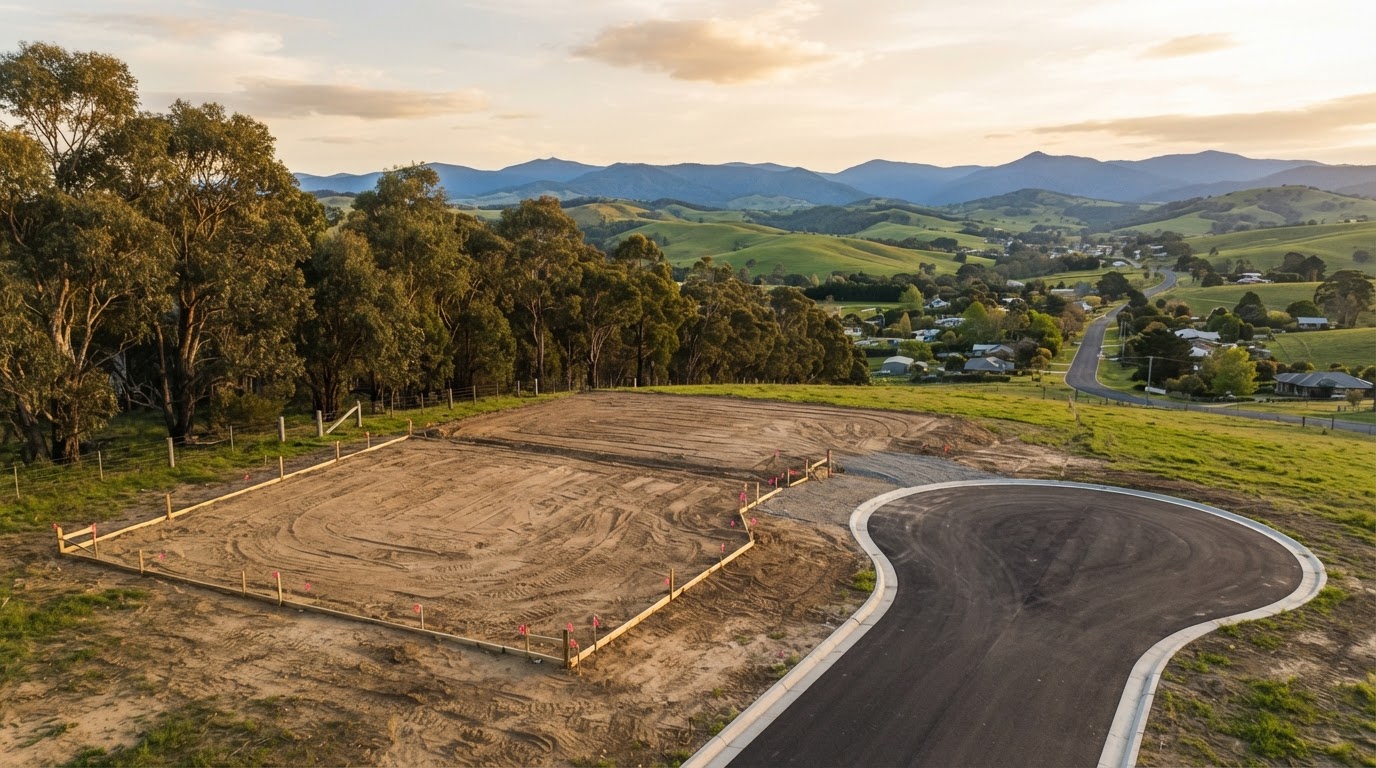
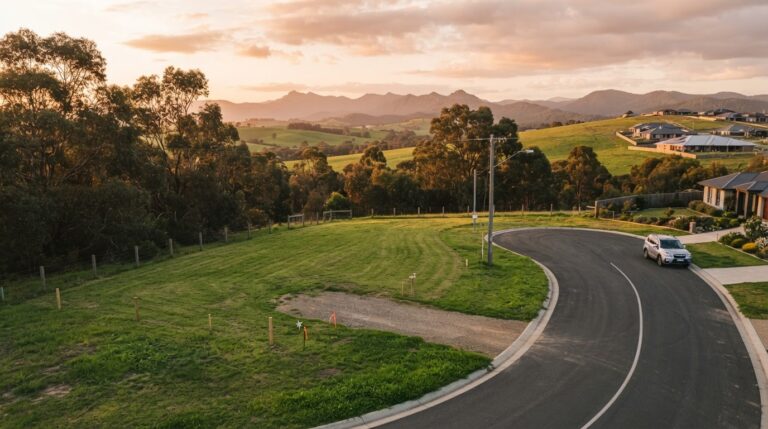
In the meantime, the serviced-block tier in East Gippsland is already pricing the demand. Nicholson is a useful worked example. OpenLot lists two housing estates in Nicholson, and the suburb’s median vacant land price was $222,000 in January 2026 — up 77.6% since October 2015. A serviced block on a sealed cul-de-sac such as Floreani Place — graded, titled, with sewerage and underground power already run — is a different product to an unserviced paddock with a zoning tag, and it prices accordingly.
That distinction matters more in a two-speed market. When established house prices are being dragged higher by a hot neighbouring LGA, the serviced-block route lets a buyer decouple their entry cost from the house median and build to a budget on their own timeline. It is the same logic we unpacked in our look at the 30-year land unlock.
What it means for buyers this spring
- If you need yield, East Gippsland wins. A 4.45% gross yield against 4.05% in Wellington, with a lower entry price, is the more forgiving starting point.
- If you need growth, Wellington has already delivered it. Sale’s 16.8% annual gain is real, but you are paying for it — and buying near the top of a fast move carries its own risk.
- Watch the stock numbers, not the headlines. FoundIt’s Listings Surge September 2026 report flagged correction risk in 56 areas where inventory exceeded five months of demand (realestate.com.au). Rising spring supply changes the negotiating position in both LGAs.
- Build-versus-buy is live again. With land repricing faster than houses in some pockets, a serviced block plus a fixed-price build is worth running as a genuine alternative, not just a fallback.
What to watch next
Three things will settle this comparison before summer. First, spring listing volumes in Sale and Bairnsdale — if Wellington’s stock builds while clearance softens, its growth premium narrows. Second, the C161egip timeline: council’s consideration of submissions, and whether a planning panel is required, determines when that pent-up Lakes Entrance land actually reaches the market. Third, the land-versus-house price spread. As long as serviced blocks in the $220,000 to $240,000 band hold while established house medians climb, the build route keeps winning on pure arithmetic.
The wider region is not one market. It is a fast lane and a value lane, running side by side, and spring is when the distance between them becomes clearest.
Related Coverage
- East Gippsland Property Market Mid-2026: What the Permit Register Says
- East Gippsland Land Supply: Nicholson and the 30-Year Unlock
- Nicholson 3882 Has Two Estates Now — And They Sell Different Dreams
- Nicholson 3882 Elevated Blocks: What $700K–$975K Buys You in 2026
- Stratford Property Market 2026: Wellington Shire Is Quietly Outpacing
- Lucknow’s 600-Home Pipeline: East Gippsland’s Next Growth Front

2 Comments