
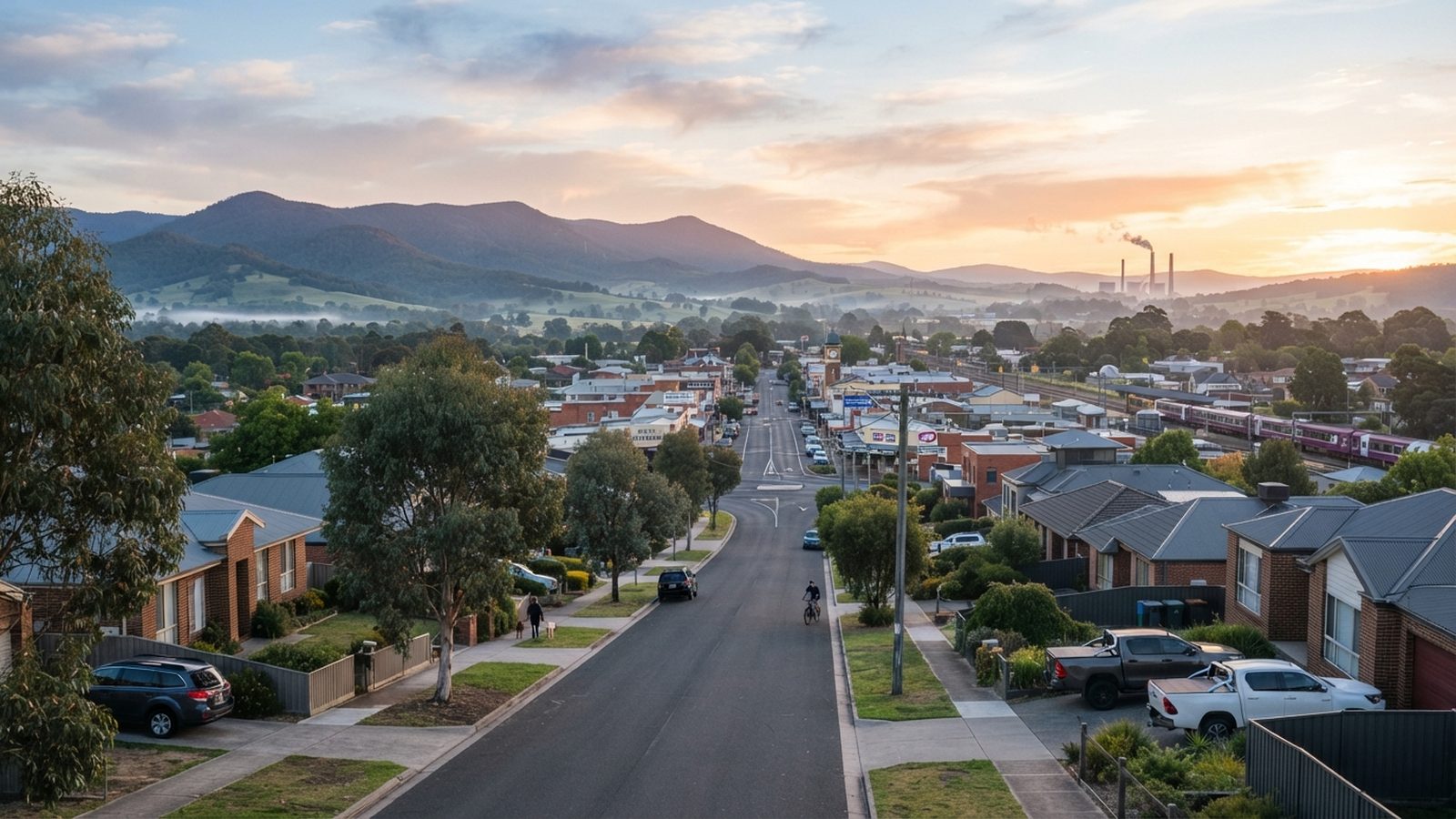
Why Wellington Led Gippsland’s Best Quarter in Five Years
The June 2026 Cotality (formerly CoreLogic) Home Value Index data has landed, and Gippsland is no longer just “doing well.” The Latrobe-Gippsland SA4 — the broad statistical area that wraps Traralgon, Morwell, Moe, Warragul, Sale, Maffra and Bairnsdale — ranks third in Regional Victoria for 12-month growth at +15.9% year-on-year, with a median dwelling value of $517,896 (per the Latrobe Valley Express coverage of the Cotality HVI June 2026 release). That is the strongest quarterly print the region has produced in five years, and it is reshaping how buyers should read the regional Victorian property market.
For anyone who’s been tracking the Gippsland property market through the usual Melbourne-buyer lens — “regional Victoria is steady, the Latrobe Valley is cheap, the coast is premium” — the June 2026 numbers force a reset. The interior is no longer cheap. The interior is leading.
The Snapshot: Cotality June 2026
The Cotality (formerly CoreLogic) Home Value Index for June 2026 is the key data anchor. The headline figures for the Gippsland region:
- Latrobe-Gippsland SA4: +15.9% YoY, median $517,896 (rank #3 in regional VIC growth).
- Wellington SA3: +12.0% YoY, median $485,285 (rank #7 in regional VIC growth).
- Stratford (VIC 3862): +12.8% YoY (Latrobe Valley Express, citing Cotality).
- Bairnsdale: +12.6% YoY, median house $813,250 (Bairnsdale Prime Market Report, 27 May 2026).
- Glengarry (VIC 3854): +7.5% YoY (Cotality).
- East Gippsland Shire 5-year CAGR: +9.7% per annum (March 2026 Economic Insights Report).
Two of those numbers — the Latrobe-Gippsland SA4 at +15.9% and Wellington SA3 at +12.0% — are the headline regional-Victoria stories. The Cotality comparator table has the Latrobe-Gippsland SA4 sitting behind only two other regional-VIC SA4s for 12-month growth, and comfortably ahead of the regional-Victoria average. For comparison, Regional Victoria as a whole is tracking around +7-8% YoY across the first half of 2026.
Why The Interior Is Outperforming
Three drivers explain the Wellington and Latrobe-Wellington corridor outperformance. None of them is a single “boom” factor — they compound.
First, the affordability gap with Melbourne has reopened. Melbourne’s median dwelling value sits at roughly $790,000 in mid-2026, and the inner-city rebuild cycle has pushed first-home buyers out two or three rings. The Latrobe Valley and Wellington corridor now offers modern house-and-land packages at $450,000-$550,000 — a price band that simply doesn’t exist in the metropolitan growth corridors any more. The 2026 First Home Buyer Gippsland guide documents the $10K regional first-home-owner grant and the 5% deposit scheme that have made this corridor the first port of call for buyers priced out of the Melbourne fringes.
Second, the development pipeline has finally turned on. Until 2025, the Latrobe Valley had a planning-approved townhouse and subdivision pipeline that was sitting on the shelf. Coverage in our Traralgon townhouse pipeline piece documents the 2026 inflection — projects that were approved in 2022-23 are now titled, civil-works complete, and homes are being delivered. That supply hasn’t been enough to slow the price growth; it’s been enough to absorb the new demand without forcing buyers into a bidding-war pattern.
Third, infrastructure is closing the commute gap. The Princes Highway duplication between Traralgon and Sale, the Princes Highway upgrades around the East Gippsland corridor, and the ongoing investment in regional rail have all shortened the effective distance between the Latrobe-Wellington corridor and Melbourne. The buyer pool is no longer purely local — it’s now drawing Melbourne first-home buyers willing to commute on alternating days, retirees downsizing from the eastern suburbs, and remote workers who can live three hours from the CBD and still hit the office twice a week.
Wellington Shire: The Quiet Leader Inside The Region
Wellington SA3 at +12.0% YoY is particularly interesting because it bundles several very different markets — Sale, Maffra, Stratford, Rosedale — into a single statistical unit. The breakdown matters:
- Sale: Recent reporting puts the median around $548,000 (Instagram market update citing recent sales), with the RAAF base and the Gippsland Grammar employment drivers underwriting steady demand. Our Sale suburb profile covers the underlying economics in detail.
- Maffra: The HtAG July 2026 dataset shows a median of $569,000, weekly rent $447, and a 4.07% gross yield — one of the strongest yields in the region. The 10-year price growth is +97.5%. The Maffra suburb profile walks through why this small town is outperforming.
- Stratford: +12.8% YoY (Latrobe Valley Express, citing Cotality). Stratford is the small-town rural-residential market that has suddenly caught the eye of Melbourne tree-changers — the proximity to Sale, the river frontage, and the affordable acreage stock all align.
The Wellington Shire planning scheme changes flowing from VC312 (Victorian Planning Scheme Amendment VC312) are also feeding the supply side. Coverage in our Wellington Shire planning pulse piece documents the rezoning updates affecting the Rural Living Zone — the kind of incremental land-supply change that takes 12-18 months to show in median prices but is clearly already in the Cotality data.
Where The Rally Doesn’t Reach
It would be a mistake to read “+15.9% YoY” as “all Gippsland is up.” The Cotality data plus the regional sub-market numbers show the rally is concentrated in the coastal premium segment and the Latrobe-Wellington corridor. The alpine and high-country Gippsland markets are still tracking flat to modest growth.
Omeo (VIC 3898) — the high-country market east of the Great Dividing Range — has a median house price of $472,500 and 12-month growth of just +2.2% (per the realestate.com.au Omeo profile). That is less than half the regional average, and a clear signal that the rally is being driven by the buy-side of the catchment, not by uniform supply pressure across the whole region. Buyers looking at “Gippsland property” as a single exposure should disaggregate.
What The Next Two Quarters Look Like
Three things to watch:
- Melbourne’s first-home-buyer flow. The 5% deposit scheme and the $10K regional grant are the policy-side accelerants. If the federal conversation tightens the scheme or the grant sunsets, the buyer flow will taper and the corridor’s growth will moderate. The next 6-8 months are the test.
- Settlement volumes in the Latrobe Valley townhouse pipeline. The Traralgon development wave is the supply-side release valve. If settlement volumes run hot through Q3 2026, the median growth will moderate back toward the regional average. If the pipeline stalls, the +15.9% will hold into Q4.
- Wellington Shire VC312 implementation. The rural-living and township zoning changes flagged in our Wellington planning pulse coverage will start delivering titled lots in mid-to-late 2026. Watch the Sale and Maffra advertised planning permits for the lead indicators.
The Cotality June 2026 print is the cleanest single data point the Gippsland property market has produced in years. The interior is leading Regional Victoria, and the next two quarters will determine whether that lead holds or moderates. Either way, the conversation has shifted: Gippsland is no longer the steady regional-Victoria performer — it is the regional-Victoria outlier.
Related Coverage
For more on Gippsland property: Wellington Shire vs East Gippsland Property Market · Maffra Property Market 2026 · Sale Property Market: Wellington Shire’s Defence and Health Hub
Proudly supported by hello-clarence.com

One Comment