

South Gippsland Scheme Review: What Happens After 26 July
Submissions to the South Gippsland Planning Scheme Review closed on Sunday 26 July 2026, ending the formal community consultation phase of a review that has been on the council’s calendar since 2022. For property watchers across the coastal strip from San Remo through Wilsons Promontory, the question is now straightforward: what happens between 26 July and a council response, and what is the review likely to change for buyers?
Where the review sits in the cycle
Every Victorian council is required to undertake a planning scheme review every four years under section 4A of the Planning and Environment Act 1987. South Gippsland’s last review concluded in 2022, so the 2026 cycle is the council’s scheduled turn. Reviews can recommend scheme amendments, hold the line on existing zones, or flag issues for a future minister-approved amendment.
Submissions are not votes. Council planning teams read them, weight them against technical evidence and strategic work, then publish a consultation summary report alongside a recommended response. That response goes to a future ordinary council meeting, where councillors either accept, vary, or reject the officer recommendation.
What the shire already said it was reviewing
South Gippsland Shire’s project page on the Have Your Say platform framed the review around four themes: housing diversity and supply, agricultural land protection, tourism and short-stay accommodation, and climate / coastal hazard overlays. Anyone who watched the submission window would have seen those four threads dominate the formal feedback, alongside repeated concerns about rural-residential rezoning near Leongatha and Korumburra.
The council also released a background report earlier in the cycle noting that the shire’s population is forecast to grow from around 30,200 (2024) to 32,500 by 2036, with the strongest growth projected in the southern corridor (Wonthaggi-Inverloch area) rather than the dairy towns inland.
The three things buyers should watch
- Whether housing diversity is unlocked in growth towns. If the council accepts an officer recommendation to expand the GRZ in part of Leongatha or Wonthaggi, expect a wave of townhouse and small-lot subdivision applications through 2027.
- How the shire treats rural living zones near Foster and Fish Creek. These zones were the most contested in the public drop-in sessions in May, and any tightening here cuts directly into lifestyle-acreage supply.
- Short-stay accommodation caps. Phillip Island sits outside the shire, but coastal towns like Venus Bay, Sandy Point and Walkerville are inside South Gippsland. A cap on nights-per-year or a permit trigger would materially change the investment maths on those properties.
How this lands on the ground
Even where the council accepts a recommendation, scheme amendments still need authorisation from the Minister for Planning before they take effect. In practice that means a buyer looking at a Leongatha townhouse today should not assume the supply will arrive on their timeline. Realistic lag from “council resolves” to “amendment gazetted” is twelve to eighteen months, and that is on the fast side.
For lifestyle buyers eyeing a few hectares near the coast, the more immediate signal is what the council signals in the consultation summary report, which is typically released a few weeks after submissions close. That document tells you what officers have weighed, what they have dismissed, and which issues have survived into the formal response.
How South Gippsland 2026 compares
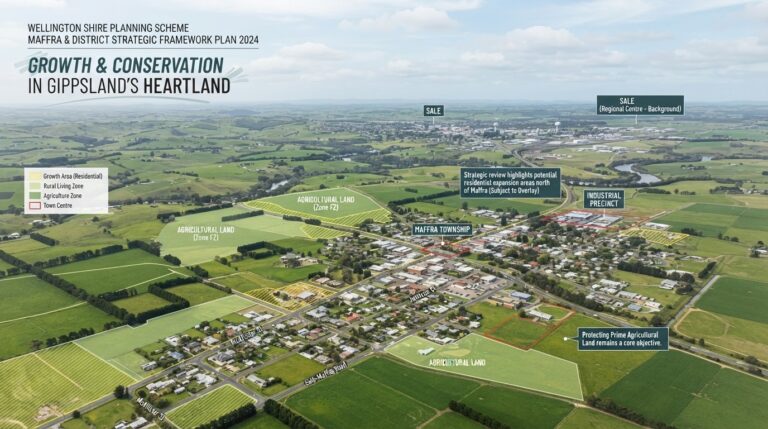
This is not Wellington Shire’s exercise. Wellington Shire wrapped a planning pulse in mid-2026 and has been actively pushing VC312 changes through the rural living zone, particularly around Maffra. South Gippsland’s review is broader in scope and slower in machinery, but the questions buyers ask are similar: where will the next supply come from, and which zones will the council defend?
It is also different from East Gippsland, where the development watch is being driven by an active permit register rather than a planning scheme review. East Gippsland has not opened a full scheme review in this cycle; South Gippsland is the only one of the three eastern-region LGAs doing so.
What to do now if you are buying
- Pull the council’s draft background report. It still lives on the Have Your Say page and frames the council’s working assumptions.
- Watch the ordinary council meeting agenda page for the next item titled “Planning Scheme Review Response”.
- If you are looking at coastal lifestyle property, line up the current short-stay accommodation register and check whether your target property has an existing permit.
- If you are looking at rural-residential land near Leongatha, ask your conveyancer whether the title sits inside a Farming Zone or Rural Living Zone, because the answer changes what the council is likely to do over the next 18 months.
Related coverage
- South Gippsland Planning Scheme Review: Have Your Say Before 26 July 2026 — our pre-submission guide for buyers who wanted to comment.
- Wellington Shire Planning Pulse July 2026: What VC312 Means for Sale, Maffra & the Rural Living Zone — how the western neighbour is using a different lever.
- Wellington Shire vs East Gippsland Property Market — broader read across the two LGAs.
- East Gippsland Development Watch: What the Advertised Planning Permits Tell Us About 2026 — the permit-register approach South Gippsland does not have.
Proudly supported by hello-clarence.com
One Comment