
Wellington Shire vs East Gippsland Property Market
The Wellington Shire vs East Gippsland property market comparison is a question that comes up often with buyers looking at the Gippsland corridor east of Traralgon. The two shires sit side by side, share the Princes Highway, and overlap on buyer cohort — but the underlying economics are different enough that the market behaves differently in each. This post draws on the ABS 2021 Census QuickStats for Wellington Shire (LGA26810) and East Gippsland Shire (LGA22110) to lay out the structural differences. For current sale prices and listing volumes, the Domain and realestate.com.au portals are the live data sources; the figures below are 2021 census baselines, not current sale medians.
The two shires side by side
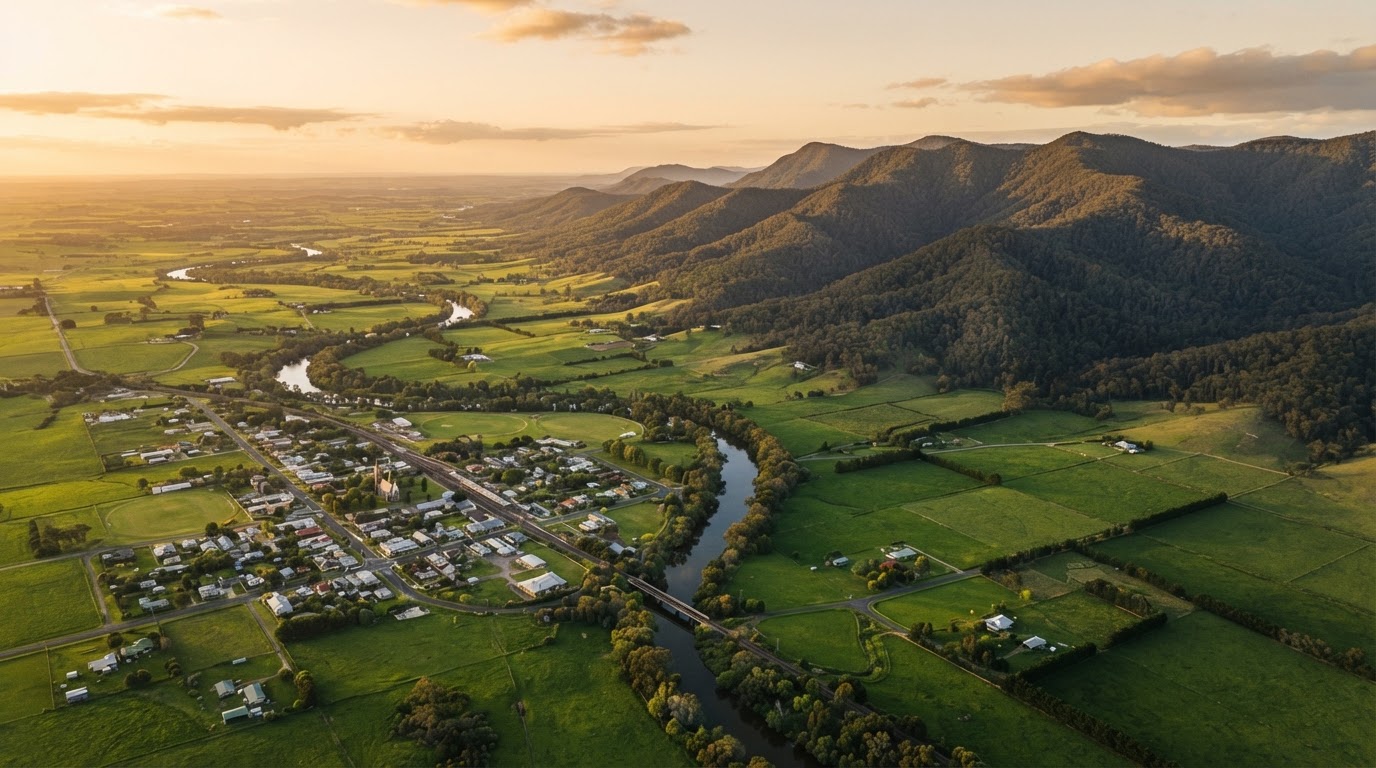
Wellington and East Gippsland are the two local government areas that make up the eastern half of the Gippsland region. Wellington runs from the Great Dividing Range down to the Ninety Mile Beach and includes Sale, Maffra, Stratford, Heyfield, Rosedale, and Yarram. East Gippsland sits further east and includes Bairnsdale, Lakes Entrance, Paynesville, Orbost, and Omeo. The Princes Highway connects them, and a buyer looking in one shire will almost always end up comparing the other.
Population is similar in scale but not in profile. The ABS 2021 QuickStats for Wellington record 45,639 usual residents (up 6.2% from 42,983 at the 2016 census) and 23,503 private dwellings. The East Gippsland QuickStats record 48,715 residents and 25,948 private dwellings.
Dwellings per resident are nearly identical: 0.51 in Wellington and 0.53 in East Gippsland. Both are higher than the metropolitan average for the comparable population band, which is the structural signature of secondary and holiday housing stock sitting alongside permanent stock.
Income and age: the real divide
Where the two shires diverge sharply is on income and age:
- Wellington median weekly household income: $1,272
- East Gippsland median weekly household income: $1,110 — about 13% lower
- Wellington median age: 44
- East Gippsland median age: 52 — the highest of any Gippsland LGA and a clear retirement-and-lifestyle pull signal
- Wellington average household size: 2.3
- East Gippsland average household size: 2.2
Wellington’s income base is anchored in defence (RAAF Base East Sale), regional health (Central Gippsland Health), and a working agricultural sector. East Gippsland’s income base is anchored in tourism, retirement, and a smaller agricultural and forestry footprint. The age gap is what most directly drives the property market divergence: Wellington’s buyer pool skews towards working-age families and first-home buyers; East Gippsland’s skews towards retirees, sea-changers, and lifestyle migrants.
Mortgages, rents, and the curious $1,300 line
Here is the most surprising figure in the comparison. Both shires report an identical median monthly mortgage repayment of $1,300 at the 2021 census. Median weekly rent is also close — $260 in Wellington, $268 in East Gippsland.
That identical mortgage figure is not a coincidence. It is the structural signature of the regional Victorian mortgage market: most borrowers in this bracket are on standardised variable-rate loans, and the median repayment is a function of dwelling value and outstanding balance rather than of local income. What it means in practice is that debt service takes a bigger relative bite out of household income in East Gippsland than in Wellington — roughly 41% of monthly household income in East Gippsland versus 36% in Wellington, using ABS weekly income figures grossed up.
For investors and yield-focused buyers, the rent differential barely closes that gap. East Gippsland’s $268/wk median rent is 3% above Wellington’s, but the difference is well inside the noise band of any individual property.
What the data says about buyer behaviour
Three patterns follow from the LGA-level numbers:
- Wellington absorbs first-home-buyer demand that cannot afford the Latrobe Valley. Sale’s $1,327/wk median household income (from the ABS 2021 QuickStats for Sale itself) is well above the regional average, and the combination of a younger population and a public-service employment base produces a steady pool of entry-level buyers.
- East Gippsland attracts lifestyle and retirement buyers with less sensitivity to commute. The 52 median age and 0.53 dwellings-per-resident ratio point to a market that includes a meaningful share of second-home and lifestyle property, and a buyer pool that is less dependent on local employment.
- Both shires have a stock of dwellings that is not permanently occupied. The dwellings-per-resident ratio is the giveaway. Some portion of the private dwelling stock in both shires is holiday housing, investment property, or intermittently occupied family homes. That is part of why sale volumes and days-on-market in the live portals tend to be lower than population alone would suggest.
What this does not tell you
The LGA-level ABS data is a structural baseline. It does not show current sale medians, current listing counts, current days on market, or current auction clearance rates. For that, the live portals — Domain and realestate.com.au — are the working sources. ABS 2021 census figures are also now four years old; the macro picture they paint still holds, but interest rate movements since 2021 have pushed median repayments higher in dollar terms across all of regional Victoria.
For a current-pricing read in either shire, the most useful entry points are:
- realestate.com.au Wellington Shire listings and the East Gippsland listings for current sale stock and asking prices
- Domain suburb profile pages for Sale, Maffra, Bairnsdale, Lakes Entrance, and Paynesville for current median sale and rent figures
- The Wellington LGA QuickStats and East Gippsland LGA QuickStats for the underlying census baseline
The bottom line
Wellington Shire and East Gippsland Shire are not the same market. The income gap ($1,272/wk vs $1,110/wk) and the age gap (44 vs 52) are large enough that they drive materially different buyer behaviour, even though the median mortgage repayment sits at the same $1,300. Wellington is a working-age, employment-anchored market with stronger entry-level demand. East Gippsland is a retirement-and-lifestyle market with a larger share of secondary and holiday housing stock. Buyers priced out of the Latrobe Valley should look at Wellington first if employment matters and East Gippsland first if lifestyle and water access matter. Both have room to negotiate in a 2026 market where listing volumes have recovered from the 2023-2024 trough.
Related Coverage
For more on Gippsland property: Maffra Property Market 2026: Why This Wellington Shire Town Is Quietly Outperforming · Sale Property Market: Wellington Shire’s Defence and Health Hub
Proudly supported by hello-clarence.com

8 Comments